
Nutrition Label Reading 101
- Aug 5, 2015
- 5 min read
You're walking through a grocery aisle picking up a few items for dinner tonight. You grab the last item you need. As you look at the package, you flip it over and BAM! A bunch of numbers, symbols, and words are listed on the package. What is it? Why is it necessary? What does it even mean?
Okay, so most of us know what a nutrition label is. We've seen them on the packages of food we buy and, in general, know what some of the information is used for and means. But, time and time again I come across people who don't really understand what they're reading or how useful a nutrition fact panel ("nutrition label") can be! They're not just some label that the government says that food companies have to put on their products (okay, they are...but they're so much more than that!). The labels can actually provide us with useful information to make better informed purchasing decisions and to better decide what foods to put in our bodies!
Let's face it, not all of us can afford to purchase whole foods, organic, non-processed, blah, blah, blah. I get it! These whole foods don't usually have labels on them. So we're told by Food Babe and other so-called experts of the blogosphere that these are the only foods you should be eating or you'll blow up and die of cancer (at the same time...). While I do agree that whole foods are better for our bodies, I know it's not always realistic and I believe in balance and moderation in everything. My goal is to give you all the tools to arm yourselves with when you're in the grocery store and deciding which food to purchase that has a *gasp* list of ingredients that's more than 1 item long! I believe in the power of information, not fear-mongering.
*stepping off my soap-box now*
So class, let's begin!

This is a Nutrition Facts Panel aka a nutrition label. LOTS of information provided in one area. Nearly everything you would want to know about your food is right here in this box (we'll talk about ingredients later). Let's break it down piece by piece.

The serving size is defined as: the amount of food suggested by the manufacturer as a portion. SUGGESTED. This is not to be confused with portion size. A portion is what you choose to put on your plate. Those of us who look at the suggested serving size often laugh. "6 potato chips...really?! Who eats just 6??" Manufacturers have been working to make serving sizes more realistic. Have any of you noticed that the serving size on a bottle of Pepsi has increased from 8 fl oz to 12 fl oz? This is the size of their cans.

The next part of the label seems pretty self explanatory. Servings Per Container: how many servings are in the product. This tells us how many servings we would get if we ate that whole package of Oreos. The package itself is not one serving...sorry.

In this section, we see the amount of each nutrient per serving. (Remember to above...if you eat more than 1 serving, you need to multiply these by how many servings you ate). This particular product has 90 calories per 1 cup serving. 15 of those calories come from fat (I wouldn't worry too much about that one). The rest is divided up into nutrients that are of concern to most Americans: total fat, saturated fat, trans fat, cholesterol, sodium, carbohydrates, fiber, sugar, and protein. Now, I don't want to get into the nitty-gritty of how much of each of these things you should have. Every person is different and needs a different amount of each. But here is the gist:
Limit: total fat, saturated fat, trans fat, cholesterol, sodium, and added sugars.
Increase: dietary fiber and protein.
This is a major simplification of these nutrients. But for this class, I'm not going to go into detail. That's for another time! Suffice it to say, most of you know which nutrients are of the most concern.
What about those weird percentages that just seem to hang out on the side?

These are called the Percent Daily Vaues (%DV). Percent Daily Values show what percent of calories that amount of a nutrient makes up in a 2000 calorie diet. So, if you need less than 2000 calories, which many of us do, then these percentages will be different for you. Confusing, right? I tend to disregard these most of the time. The only time that I usually recommend looking at these is when you're looking at fat or sodium content. For the most part, if a nutrient is >20% DV, then it is high and you should limit your portions (and servings too!).
So there you have it. That's the bulk of a nutrition label. The next part, the ingredients, gets a little trickier if you don't know what you're looking for.
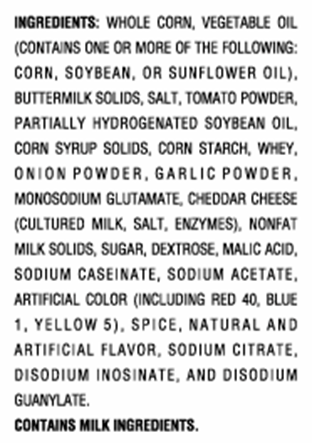
For those of you with allergies, this is your best friend. To those of us who don't have allergies, this list is still useful. It tells us what is in the product, by weight. That means, that the first ingredient listed is what the product mostly is. In this case, this product is mostly whole corn.
When looking at the ingredient list, it can be easy to get overwhelmed. Especially with things you don't know how to pronounce (cyanocobalamin, anyone?). One thing I want to make clear: just because you can't pronounce it or don't know what it is, doesn't mean the ingredient is bad for you. Fear-mongerers like Food Babe would like you to believe that if a third-grader cannot pronounce something, then you shouldn't put it into your body. I don't know about you, but I couldn't pronounce "quinoa" as a third-grader but you bet your buns I would put it in my body! By the way, cyanocobalamin is vitamin B12 - essential to your body.
So, what should you look for when you're avidly reading the ingredient list?
1) Whole Grains

To determine if a product is whole grain, you must look at the ingredients. If it's listed as the first ingredient, congratulations. You've found yourself a whole grain! Now, many products are "whole grain rich" which means that they have whole grain, but not all of the product is. That's okay, but you should should for ones that only have whole grains. These contain more fiber (good for your bowels and cholesterol), good fats, and vitamins and minerals.
2) Trans Fats

These fats have no place in our diet. Numerous research studies have shown that trans fats are something that we should avoid. Our bodies cannot process them and they contribute to heart disease. Manufacturers can be deceiptful little twerps as they are allowed to list "0g" on anything that contains <0.5g per serving (remember your new label reading skills?). This is fine and dandy unless you eat more than 1 serving. The only way you'll truly know if your product contains trans fat is to look at the label. You're looking for "partially hydrogenated _____ oil." When you see this, you have trans fat. Avoid this!
3) Added Sugars

A sugar by any name will still be as sweet...you've probably heard "if it rhymes with 'gross,' it's sugar." And you wouldn't necessarily be wrong. Dextrose, Sucrose, Glucose, Fructose, Galactose, Maltose, and Lactose are all sugar. But, so are corn syrup, honey, high fructose corn syrup, cane juice, cane sugar, etc. Limit these!

So that's how to read a nutrition label! In recent months, the FDA has been proposing changes to the current nutrition fact panels. Here are their proposed changes:

Photo credit: Food and Drug Administration This infographic from the FDA sums up the proposed changes.

A recent proposed changes as of July 2015 is to include the %DV for added sugars and to update the footnote explaining %DV to consumers. For more information on the proposed changes, click HERE.


Comments