
Artificial Sweeteners - Villains or Allies?
- May 4, 2016
- 7 min read

What are artificial sweeteners and who are they regulated by?
Artificial sweeteners are also known as “sugar substitutes” or “non-nutritive sweeteners” are chemically made substances that are used in place of sugar or sugar alcohols in foods or beverages. They are called non-nutritive sweeteners because they do not provide calories when digested.
Humans have always loved sweet foods. The first recorded sweetener was honey. Honey was later replaced by sucrose (table sugar) that came from sugar cane, originally. During both World Wars, sugar beets were the main source of sucrose. The first artificial sweetener, saccharin, was developed in 1879 and was well accepted during both wars because it was cheap to produce and sugar was in such low supply. After the wars, sugar became affordable again, but with a growing supply of candy and fast food, Western cultures were becoming more obese. So, in the 1950's, the reasons for using saccharin shifted from cost to calorie reduction. The market for diet products was very popular and profitable. However, saccharin was known for it's very bitter aftertaste, so scientists worked to create new artificial sweeteners that would be better accepted in food. The next to be developed was cyclamate in the 1950's, which had a better taste than saccharin and blended well with it. These were mixed together and were sold as "Sweet N' Low." However in 1970, the U.S. Food and Drug Administration (FDA) banned cyclamate from all U.S. foods citing cancer caused by cyclamate in experiment animals. Since then, the findings have been re-examined and scientists have concluded that cyclamate is not a carcinogen, or cancer causing. However, the FDA has not approved a petition to allow it back into food supply. After the development of cyclamate, the artificial sweetener industry took off.
Artificial sweeteners are regulated by the FDA under the Food, Drug, and Cosmetic Act passed by Congress in 1958. Before artificial sweeteners can hit the shelves, the FDA must approve them. However, this does not include products that are “generally recognized as safe (GRAS).”
What are the different artificial sweeteners?
To date, the FDA has approved the use of six artificial sweeteners, each one far sweeter than table sugar.
Aspartame: "Equal" or "NutraSweet" A combination of two amino acids - phenylalanine and aspartic acid. It is 180 times sweeter than sugar. One of the earliest artificial sweeteners. It loses its sweetness when exposed to heat. Best used in beverages instead of baking.
Acesulfame-K: "Sunett" or "Sweet One" Can be added to food at the table. Is often used with other sweeteners in carbonated low-calorie beverages. This artificial sweetener is most similar to table sugar in taste and texture. Is 200 times sweeter than sugar. It is heat stable so it can be used in cooking and baking.
Saccharin: "Sweet N' Low" or "NectaSweet" Is 300 times sweeter than sugar. It is used in many diet foods and drinks, but is not used for cooking or baking. It may have a bitter or metallic aftertaste in some liquids.
Sucralose: "Splenda" Is 600 times sweeter than sucrose. It is used in many diet foods and drinks, gum, frozen desserts, fruit juices, and gelatin. It can be added to food at the table. There is a story about how sucralose was discovered. A company in London in 1976 was searching for a way to blend sucrose with lab chemicals. When the professor left a message for his graduate student to "test" some of the products, the graduate student mis-heard this as "taste" and tasted the sample. Lucky for him, it was not toxic, and sucralose was discovered. It is sucrose with chlorine attached.
Neotame Used in many diet foods and drinks and as a tabletop sweetener.
Stevia is a plant-based sweetener made from the plant Stevia rebaudiana. Stevia, as a whole leaf or crude extract has not been approved for use in the U.S. Only highly refined Stevia preparations have been referred to as GRAS by the FDA - rebaudiana extract.
What have studies shown about using artificial sweeteners to help with weight loss?
There is conflicting research surrounding the overall health benefits of artificial sweetener use. Long-term studies have shown that regular consumption of artificially sweetened beverages does reduce the intake of calories and promotes weight loss or maintenance, but some research shows no effect, and some studies even show that they promote weight gain. One large study followed participants for 7-8 years and examined their relationship between consuming artificially sweetened beverages and their weight. After adjusting for other weight gain factors, the study showed that those who drank artificially sweetened drinks had BMIs that were 47% higher than those who did not.
All artificial sweeteners are much sweeter than sugar. This allows them to be used in smaller amounts in food to achieve sweetness. There is concern that because the human brain reacts to sweetness with signals to eat more sweet items, by providing sweet taste without calories, artificial sweeteners cause us to crave more sweet foods and drinks which can cause calories to add up fast. In tandem with this concern is one that artificial sweeteners affect the body’s ability to gauge how many calories are being consumed. Some studies have shown that artificial sweeteners affect the brain differently than sugar does. A UCSD study found that sugar activates regions in the brain that are associated with food reward, while sucralose does not. The authors suggested that sucralose “may not fully satisfy a desire for natural caloric sweet ingestion.” So, artificial sweeteners may not be an effective way to manage sweet cravings.
Don't artificial sweeteners cause cancer?
The media, as a whole, has vilified artificial sweeteners as carcinogenic, or cancer-causing. Studies conducted in the early 1970’s linked saccharin to bladder cancer. After this, Congress mandated that further studies be conducted and that all foods containing saccharin should have a warning label. More studies in rats shows an increase in bladder cancer at high doses of saccharin, particularly in male rats. However, further studies concluded that this was due to a mechanism present in rats that is not present in humans. Because there was no clear evidence that saccharin causes cancer in humans, saccharin was removed from the U.S. National Toxicology Program’s Report on Carcinogens, in 2000 after being on the list for 19 years. Aspartame has also been under fire for supposedly causing cancer. Questions began to arise more when a 1996 report suggested that the increase in the number of people with brain tumors between 1975 and 1992 might be associated with the introduction of aspartame in the U.S. However, analysis of statistics showed this to not be causal for an increase in brain cancer. In 2005, a study found more lymphomas and leukemias in rats fed high doses of aspartame (equivalent to drinking 8 to 2,083 cans of diet soda daily, depending on dosage). However, some of the findings were inconsistent. The FDA issued a statement saying that aspartame was still safe for use. NCI examined data from the Diet and Health Study of over half a million retirees and concluded that increased consumption of aspartame-containing beverages was not associated with the development of lymphoma, leukemia, or brain cancer.
What are safe levels of artificial sweeteners that one can consume?
Regulatory agencies set Acceptable Daily Intake (ADI) levels for each sweetener. Although, intakes of artificial sweeteners have increased, the U.S. intake of artificial sweeteners is well below the ADI for even those who use them the most (dieters, adults and children with diabetes, and women of child-bearing age).
For example:
a 150 pound adult can consume 2.4 cans of 12 oz soda or 8.6 packets of saccharin daily
that same adult can consume 17 cans of 12 oz soda or 97.4 packets of aspartame daily
Many foods naturally contain the same "chemicals" as a sugar substitute, and sometimes in greater quantities than the sweetener itself. For example: a glass of skim milk provides 6-9 times more phenylalanine and 13 times more aspartic acid than a glass of beverage containing aspartame. A glass of tomato juice provides 4-6 times more methanol than a glass of a beverage sweetened by aspartame.
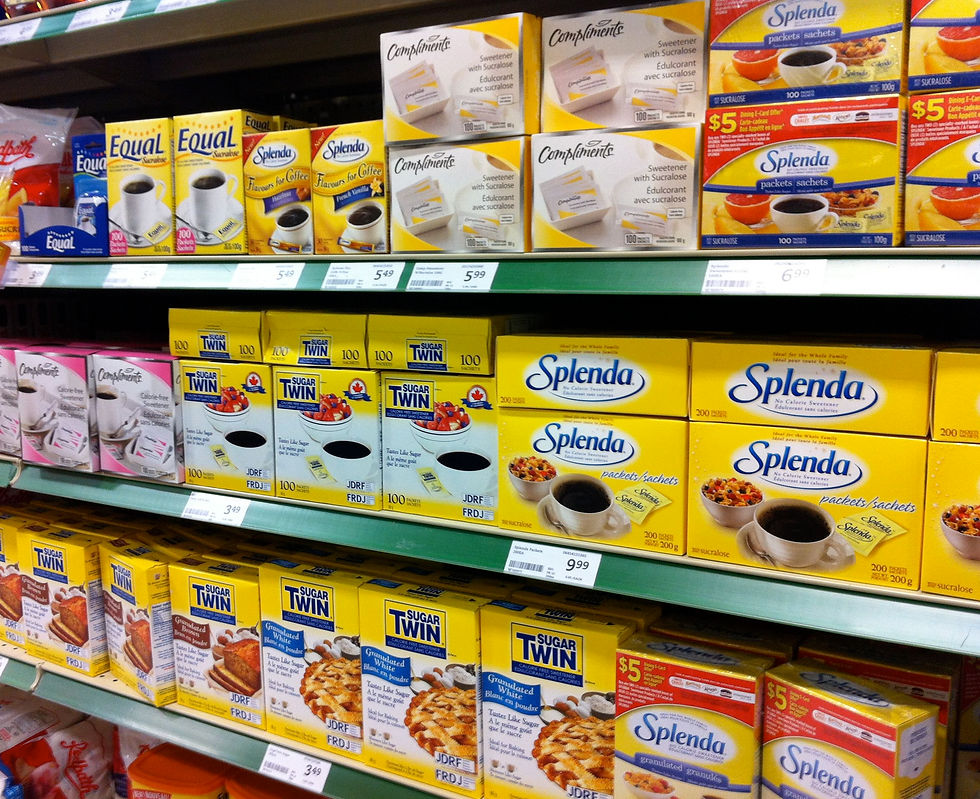
Given all of this information, the American Heart Association and the American Diabetes Association provided a statement saying that when used sparingly, non-nutritive sweeteners may help with weight loss or control. Their statement did point out that these potential benefits are negated if there is a equal increase in caloric intake from other sources.
(image: Eat Spin Run Repeat website)
What Does All of This Mean for Me?
If you are healthy and have no weight or glucose issues and are currently consuming a lot of artificially sweetened foods or beverages, keep your intake moderate.
If you have diabetes or high blood sugar, reconsider having an "unlimited" amount of artificial sweeteners.
If you struggle to lose weight or crave sugar after eating sweet foods, consider decreasing your artificial sweetener use. As mentioned above, constant use of artificial sweeteners can actually cause us to crave sugar more.
DON'T: start adding sugar instead. Added sugar in your diet is moving in the wrong direction. Added sugar comes with its own host of issues.
The general take home is that artificial sweeteners, just like added sugar, are to be used sparingly and in moderation as part of a balanced diet.
(cover image from Ask Georgie blog)
Resources:
1) "Sweeteners - sugar substitutes." U.S. National Library of Medicine. National Institutes of Health. https://www.nlm.nih.gov/medlineplus/ency/article/007492.htm. Updated January 15, 2016. Accessed May 4, 2016.
2) Weihrauch M, Diehl V. "Artificial sweeteners - do they bear a carcinogenic risk?" Ann Oncol. 2004; 15(10): 1460-1465. doi: 10.1093/annonc/mdh256
3) "Artificial Sweeteners and Cancer." National Cancer Institute. National Institutes of Health. http://www.cancer.gov/about-cancer/causes-prevention/risk/diet/artificial-sweeteners-fact-sheet. Reviewed August 5, 2009. Accessed May 4, 2016.
4) "What refined Stevia preparations have been evaluated by FDA to be used as a sweetener?" U.S. Food and Drug Administration website. http://www.fda.gov/AboutFDA/Transparency/Basics/ucm214865.htm. Updated March 4, 2016. Accessed May 4, 2016.
5) "Artificial Sweeteners." Harvard T.H. Chan School of Public Health website. http://www.hsph.harvard.edu/nutritionsource/healthy-drinks/artificial-sweeteners/. Accessed May 4, 2016.
6) Marcason W. "Sugar Substitutes: How Much is too Much?" Academy of Nutrition and Dietetics website. http://www.eatright.org/resource/food/nutrition/dietary-guidelines-and-myplate/sugar-substitutes-how-much-is-too-much. Published February 11, 2015. Accessed May 4, 2016.
7) Fear G. "How Artificial Sweeteners Can Impact Metabolism: New Data." Ask Georgie webiste. http://askgeorgie.com/how-artificial-sweeteners-can-impact-metabolism/. Accessed May 4, 2016.


Comments