
Whole Grains: What You Need to Know
- Sep 20, 2016
- 13 min read

The most recent Dietary Guidelines for Americans state the we are supposed to make half of our grains whole, which amounts to about 3-5 servings per day of whole grains. Children require slightly less at about 2-3 servings. Unfortunately, many of us fall short of this goal. Why is it so tough for us to meet this goal and why are whole grains so important? If you've ever asked yourself these things, then read on!
What are Grains?
Grains are any food made from wheat, rice, oats, cornmeal, barley, oats, or any other cereal grain.
amaranth
barley
brown rice
buckwheat
bulgur
millet
oatmeal
quinoa
sorghum
triticale
barley
rye
wild rice
spelt
teff
wheat berries
couscous
farro
muesli
corn
What's a Whole Grain?
A grain is considered whole if it contains its three original parts: the endosperm, germ, and bran, in the same proportions as when the grain was growing in the field.
The bran is the multi-layered outer shell of the kernel of grain. It contains the fiber, many B vitamins, and important antioxidants.
The germ is the part of the grain that is the embryo; which could potentially sprout into a new grain plant. It contains some protein, many B vitamins, and healthy fats.
The endosperm supplies the grain kernel with food, to give the young plant energy to grow. It contains starchy carbohydrates, some protein, and small amounts of vitamins and minerals.
What's the Difference Between Whole Grains and Refined Grains?
"Refined grain" is a term used to describe a grain that does not contain all three parts of the grain kernel. Many refined grains have the bran and germ removed so all that is left is the endosperm. Refining a grain removes the fiber, about a quarter of the protein, and a half to two-thirds of the nutrients.
In the late 1800's, new milling technology allowed grains to be refined cheaply and easily. Once this happened, most of the grains around the world have been eaten as refined grains. This lead to nutrient deficiencies that caused diseases such as beri-beri and pellagra. In response to this, many governments, including the U.S., required that refined grains be "enriched," meaning that nutrients needed to be added back after the bran and germ were removed. B vitamins and iron are added back as well as folate, but no fiber.
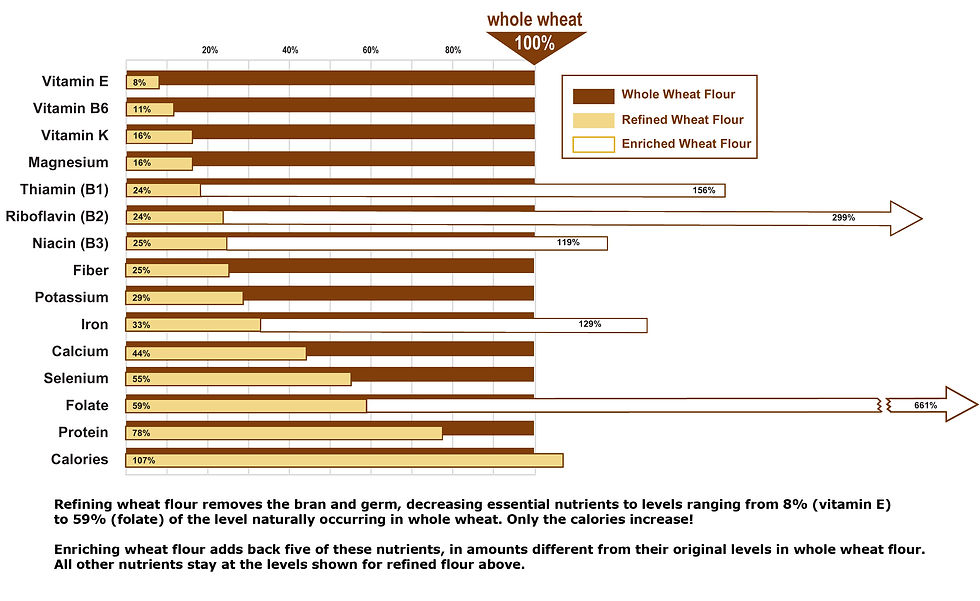
Image: Whole Grain Council
What are Ancient Grains?
There is no official definition for "ancient grains." In fact, all grains are "ancient" since they can trace their roots to the beginning of agriculture. However, the Whole Grains Council defines "ancient grains" loosely as those that have changed very little over the last several hundred years. This means that modern wheat is not an ancient grain, but Kamut, farro, and spelt would be ancient grains in the wheat family. Many grains, largely ignored by Americans until recently, are considered ancient grains: amaranth, sorghum, quinoa, millet, and teff.
Ancient grains are whole grains and are more nutritious than refined grains. However, whole grains need not be 'exotic' to provide health benefits. Brown rice, oatmeal, and whole wheat bread provide the same whole grain benefits and often cost much less.
What are Sprouted Grains?

Grains are seeds of plants. Like any plant seeds, grains sprout when temperature and conditions are just right. Until then, the grain relies on natural growth inhibitors to keep it from sprouting. Once sprouting starts, the enzymes wipe out this inhibitor and transform the starchy endosperm to simpler molecules that can be easily digested by the growing plant. Some people may also find the sprouted endosperm easier to digest as well. Proponents of sprouted grains claim that grains that have just begun sprouting provide all of the benefits of whole grains while being easier to digest for those that have digestive issues.
Sprouted grains are whole grains because all of the components of the grain kernel are present: the endosperm, germ, and bran, which are all required for the sprout to grow. Refined grains cannot be sprouted grains since the sprout comes from the germ and the other components of a whole grain are required to sustain the sprout. "Therefore, all sprouted grains are whole grains, but not all whole grains are sprouted grains" (6).
Several studies have been done looking at the health benefits of sprouted grains. Studies have shown that sprouting grains increases many of their nutrients: B vitamins, folate, vitamin C, and essential amino acids. One study found that folate levels tripled in sprouted wheat, and it contained more fiber than non-sprouted wheat. Another study found higher levels of antioxidants in sprouted brown rice and a separate study found that fiber increased with sprouting time and temperature. Sprouted grains also have a fuller, sweeter flavor than their non-sprouted counterparts.
Despite promising studies, there are many different variables to consider regarding the conditions the grains were sprouted in. And while there are promising studies, research is generally lacking regarding the health benefits of sprouted grains. Currently, there is no regulated definition for "sprouted grains," meaning that the studies could have used different definitions. Different manufacturers prepare them differently and define them differently, as well.
For more information on how different manufacturers define sprouted grains, click here.
Whole Grains and Health
Whole grains are great sources of: vitamins, minerals, fiber, multiple phytochemicals, and other important nutrients. The phytochemicals present in whole grains complement those found in fruits and vegetables when they're eaten together. Most of the beneficial compounds are found in the bran and germ, the parts that are milled out when refining a grain.
Statistics show that more than 1 in 3 Americans has some type of cardiovascular, or heart, disease. There is strong evidence showing that eating 3-5 servings of whole grains per day lowers risk of heart disease. The risk for developing high blood pressure, a risk factor for heart disease, is also lower among those who eat more servings of whole grains. This translates to a lower risk for heart disease and stroke.
Research also shows that those that eat whole grains have a decreased risk of developing Type 2 Diabetes. "Studies also have found an association between whole grain consumption and fasting glucose and insulin levels, as well as the risk of developing type 2 diabetes" (7).
Colon cancer is the third most common type of cancer, according to the American Cancer Society. Several studies conducted in the U.S. have found that risk for colorectal cancer is significantly reduced in people that eat the greatest amount of whole grains. A 2011 meta-analysis of multiple studies found that there was a 20% decrease in risk for colorectal cancer for every 3 servings of whole grains eaten per day, and the risk was even lower as more whole grains were eaten.
The Centers for Disease Control estimates that almost one-third of adults and 1 in 5 children and adolescents are obese, based on BMI, thus increasing their risk for multiple health conditions (high blood pressure, increased blood lipids, and type 2 diabetes). Multiple studies suggest that a diet including whole grains reduces the risk of obesity and weight gain, although the effects are not great. A 2012 study looked at the effects of whole wheat vs. refined wheat on the body and it found that after 12 weeks, eating the whole grains products resulted in a decreased body fat percentage, but no difference in weight.
No one single nutrient found in whole grains can be identified as the cause of their health benefits. There are many possible mechanisms by which whole grains may contribute to preventing diseases, such as:
prebiotic effect of whole grains in the gut, resulting in alteration of gut bacteria
pH changes in the colon
multiple bioactive compounds that have antioxidant effects
decreased glycemic index resulting in lower insulin levels
high fiber content that slows down food's movement through the gut
Reading Labels for Whole Grains
Walking down the bread aisle can be quite the ordeal. Often times, information is placed on the front of packages to grab our attention and persuade us to purchase a product over another one. There are so many different choices and we often make decisions thinking that we've made the healthier choice, but that's not always the case. We read terms like "multigrain," "stone ground wheat," "wheat flour," etc. and they make making a decision even harder. The cereal aisle is especially confusing. Many traditionally sugary cereals are listed as "whole grain" because manufacturers use multiple types of sugar so that one particular type does not make up more of the cereal than the whole grain. However, you could read the ingredients and "whole grain ____" may be listed first, but it's followed by 3 different types of sugar that, when added up, would equal more than the whole grain. How do you know that you're getting an actual whole grain product?

The Whole Grain Council has tried to make figuring this out a little easier. There are two different stamps that might be on a product. The basic stamp means that the product contains at least 8
grams of whole grains, but it may also contain some refined grains. The 100% Whole Grain stamp means that all of the grains in the product are 100% whole grain and it contains a minimum of 16 grams of whole grains, a full serving.
However, the most sure-fire way to determine if something is whole grain is to read the ingredient list. If the ingredients list the first ingredient as "whole grain _____" or "whole wheat" then the product is whole grain. But, reading the ingredients while considering the big picture is important. A product can be whole grain but also be loaded with added sugars or hydrogenated fats. If all you're concerned about is whole grains, then looking for the stamp or "whole grain" in the ingredient list will help you determine which products are actually whole grain.
Getting More Whole Grains in Your Diet
So, we know that we should eat more whole grains. And it seems pretty easy, right? However, some people have difficulty adjusting to the texture and taste, since it is a bit different. I often suggest to clients, like with pasta for example, to do half and half - half refined (or white) and half whole grain, to adjust to the taste and texture. Getting in whole grain for kids can be especially difficult. Sneaking them into crusts, baked goods, casseroles, etc. are examples of ways to get your kids to eat more whole grains. Try pairing the new whole grain product with a food they are familiar with and like. Find the whole grain alternatives of your favorite foods and give them a try! You'll be surprised by how delicious they are.
Now that you've purchased a whole grain, how do you cook with it?

Amaranth
Amaranth is native to the Aztecs and is used in traditional Mexican, Peruvian, and other Central American cuisine. It is naturally gluten-free, has three-times the calcium of other grains, and is high in iron, magnesium, phosphorus, and is the only grain that contains vitamin C. It also has 5 grams of protein per half cup, cooked and is considered a complete protein.
Cooking: Amaranth releases starches as it cooks, so the cooking liquid thickens. Use 6 cups of liquid to 1 cup of amaranth, bring to a boil, and simmer for 15-20 minutes. Then drain and rinse immediately as it will thicken if it sits. The outside will still be a bit crunchy, but the inside will be soft.
Brown Rice
Rice is one of the most common grains in the world. Just 1 cup of brown rice provides about 88% of our daily need for manganese, a mineral that helps us digest fats and utilize what we get from protein and carbs. It is also a good source of selenium. Brown rice may be substituted for any recipe that calls for white rice.
Cooking: Brown rice can take up to 60 minutes to cook, but there are pre-cooked or partially cooked varieties to cut down on this time. Use 1/4 to 1/2 cup more water per cup of brown rice than you would for white rice. Never stir the brown rice; stirring activates starch and will make the rice sticky. To get fluffy brown rice, turn off your burner when the time is up and allow the rice to sit in the covered pot for an additional 15 minutes to allow it to continue steaming.
Barley
Barley is a grain that dates back to ancient times. This grain is not gluten-free. Barley is most commonly sold as hulled or hull-less, because the hull is inedible. 1/2 cup of hulled barley provides 15g of fiber and 11.5g of protein! Barley has a chewy and nutty flavor, making this a good choice for those new to whole grains. Note: pearled barley is not a whole grain because it has had its bran removed, but it is still high in fiber.
Cooking: Barley takes longer to cook, approx. 50-60 minutes. To maximize efficiency, you could make a big batch and then freeze it for later use. When in doubt, use more water rather than less while cooking to prevent scorching and burning. Barley can be added to soups, salads, and stews among other dishes.
Quinoa
Quinoa has been gaining popularity for years. It is native to the Incas and grows in high altitudes in the Andes mountains. It is a complete protein and is naturally gluten-free. 1/2 cup of cooked quinoa contains 4g of protein.
Cooking: Quinoa has a natural coating called saponin that can cause it to taste bitter. Giving the quinoa a good rinse before and after cooking can help remove this residue. 1 cup of quinoa takes about 20 minutes to cook, but it can easily overcook. Drain the quinoa well and return to the pan after it's drained to help get rid of excess water. You'll see a "white tail" when it's done cooking. Fluff with a fork just before serving. Quinoa can be used in dishes calling for rice, in salads, or instead of noodles.
Recipes

Sausage and Barley–Stuffed Peppers
Serves 8
Ingredients 2 cups low-sodium chicken broth 1 cup water 1 cup pearl barley 2 tsp olive oil 1 lb sweet Italian-style turkey sausage, casings removed
1/2 medium yellow onion, diced 2 garlic cloves, minced 2 tsp Italian seasoning 1/2 tsp freshly ground black pepper 8-oz package sliced mushrooms 5-oz package spinach leaves, roughly chopped 2 cups marinara sauce (if using jarred, choose low-sodium) 2 oz Parmesan cheese, grated 4 red bell peppers, cut in half and blanched
Directions 1. Preheat oven to 400° F.
2. Bring the broth and water to a boil. Add the barley, cover, and reduce heat to a simmer. Cook the barley until soft but not mushy, about 55 minutes. Set aside and keep warm.
3. Heat the olive oil in a sauté pan over medium-high heat. Add the sausage and brown. When the sausage is partially cooked, add the onion, garlic, Italian seasoning, and black pepper. Cook until the onion is soft and sausage is fully cooked, about 2 minutes. Remove from skillet and set aside and keep warm.
4. Add the mushrooms to the pan and sweat until they release most of their liquid. Add the spinach to the pan and cook just until wilted but still bright green. Add the mushroom mixture to the sausage mixture. Add the marinara sauce, barley, and one-half of the cheese.
5. Stuff each pepper half with 1 cup of the filling. Cover the stuffing of each pepper with a square of foil coated in cooking spray. Place the pepper foil side down in a baking pan. Bake until the juices are bubbling, about 30 minutes.
6. Turn peppers over and remove foil. Sprinkle remaining cheese on top and serve.
Nutrient Analysis per serving Calories: 286; Protein: 18 g; Carbohydrates: 31 g; Fiber: 6.5 g; Total fat: 11 g, Sat fat: 1.5 g, Sodium: 585 mg
Lemon, Ginger, Barley Pudding With Raspberries
Enjoy this sophisticated variation of rice pudding as a dessert or as a sweet treat at breakfast. The recipe can be made from leftover barley, too.
Serves 6
Barley Pudding 2 cups cooked barley 1 cup unsweetened almond cashew cream 1 tsp vanilla extract 1/4 cup agave syrup Pinch of fresh nutmeg 1/4 tsp cinnamon 1 tsp lemon zest 1/2 tsp ginger root, minced 3/4 cup frozen, unsweetened raspberries
Lemon Ginger Cream 6 T unsweetened almond cashew cream 1 T agave syrup 1/2 tsp lemon zest 1-inch piece of peeled and sliced ginger root
Directions 1. For the barley pudding: Combine all of the ingredients except the raspberries in a heavy saucepan. Bring to a simmer and cook for 8 to 10 minutes, stirring frequently.
2. Remove from the heat and fold in the frozen berries. Allow to cool.
3. Meanwhile, combine the ingredients for the lemon ginger cream and simmer for 5 minutes. Allow to cool and remove the ginger slices.
4. Using a 1/2-cup scoop, portion the barley pudding into individual ramekins. Top with 1 T lemon ginger cream per portion and serve.
Nutrient Analysis per serving Calories: 138; Protein: 1 g; Carbohydrates: 29 g; Fiber: 2 g; Total fat: 3 g; Sat fat: 1.5 g; Sodium: 71 mg
Mediterranean Breakfast Quinoa With Walnuts, Figs, and Apricots
Serves 4
In this Mediterranean-inspired quinoa recipe, dried fruit and cinnamon contribute all of the sweet taste—no added sugars needed. Dried figs are deliciously sugary, and when joined with Turkish apricots, raw walnuts, and cinnamon, this breakfast cereal is given a decidedly Mediterranean flair.
Ingredients 1 cup quinoa, rinsed well and drained (any color—we used red) 3 cups water 4 extra large dried figs (or 8 smaller dried figs) 8 dried apricot halves 1/4 cup walnuts 1 tsp cinnamon
Directions 1. Bring water and quinoa to a boil. Then, reduce heat to low and simmer covered for about 15 minutes, until the outside coat of the grain separates into a curly tail, and all of the liquid is absorbed.
2. While the quinoa is simmering, chop the figs, apricots, and walnuts into small, bite-sized pieces. Add the chopped fruit, nuts, and cinnamon to a large bowl.
3. When the quinoa is done cooking, add to the bowl and toss with the fruit and nut mixture until combined.
4. To serve, divide the quinoa mixture among four mason jars, and add 1/2 cup milk to each jar. Cover and refrigerate overnight. (This allows the fruit to soften a bit, and also allows the flavors to mingle more freely.) Alternatively, you also can keep the quinoa mixture in a covered container in the fridge. Then, when you're ready to eat, simply scoop about 1 cup quinoa mixture into a bowl, top with 1/2 cup milk, and eat like regular cold cereal.
Nutrient Analysis per serving (about 1 cup including milk) Calories: 290; Total fat: 7g; Sat fat: 1g; Sodium: 60 mg; Carbohydrate: 47 g; Fiber: 5 g; Protein: 12 g
Recipes from: Schaeffer J. "Cooking With Whole Grains." Today's Dietitian. 2015; 17(9):46. Available at: http://www.todaysdietitian.com/newarchives/090115p46.shtml. Accessed September 14, 2016.
Sources:
1) LaBarbera M. "Parent's Guide - List of Grains." Nourish Interactive. Published February 12, 2012. Available at: http://www.nourishinteractive.com/healthy-living/free-nutrition-articles/114-grains-products. Accessed September 14, 2016.
2) "Grains." Missouri Department of Elementary & Secondary Education. Available at: https://dese.mo.gov/sites/default/files/whataregrains.pdf. Accessed September 14, 2016.
3) "What's a Whole Grain? A Refined Grain?" Whole Grains Council. Available at: http://wholegrainscouncil.org/whole-grains-101/whats-whole-grain-refined-grain. Accessed September 14, 2016.
4) "Ancient Grains." Whole Grains Council. Available at: http://wholegrainscouncil.org/whole-grains-101/whats-whole-grain/ancient-grains. Accessed September 14, 2016.
5) "Sprouted Whole Grains." Whole Grains Council. Available at: http://wholegrainscouncil.org/whole-grains-101/whats-whole-grain-refined-grain/sprouted-whole-grains. Accessed September 14, 2016.
6) Lentz L. "Whole Grains: Sprouted Grains." Today's Dietitian. 2015; 17(6): 8. Available at: http://www.todaysdietitian.com/newarchives/060415p18.shtml. Accessed September 14, 2016.
7) Webb D. "The Impact of Whole Grains on Health." Today's Dietitian. 2013; 15(5): 44. Available at: http://www.todaysdietitian.com/newarchives/050113p44.shtml. Accessed September 14, 2016.
8) Getz L. "Deciphering Whole Grain Food Labels - Separating Fact From Fiction." Today's Dietitian. 2012; 14(6): 44. Available at: http://www.todaysdietitian.com/newarchives/060112p44.shtml. Accessed September 14, 2016.
9) Hennessey M. "Truly whole grain? Reconstituted grains make that tricky, says Whole Grain Council." Bakeryandsnacks.com. Published May 29, 2014. Available at: http://www.bakeryandsnacks.com/Sectors/Milling-Grains/Whole-Grains-Council-talks-milling-challenges. Accessed September 19, 2014.
10) Schaeffer J. "Consuming More Whole Grains." Today's Dietitian. 2013; 15(2):32. Available at: http://www.todaysdietitian.com/newarchives/021313p32.shtml. Accessed September 14, 2016.
11) Schaeffer J. "Cooking With Whole Grains." Today's Dietitian. 2015; 17(9):46. Available at: http://www.todaysdietitian.com/newarchives/090115p46.shtml. Accessed September 14, 2016.


Comments